Human Condition · Essays
Crime and Punishment: a Reflection on Superiority and Worthiness
A reflection on Raskolnikov, superiority, and worthiness through a rereading of Crime and Punishment.
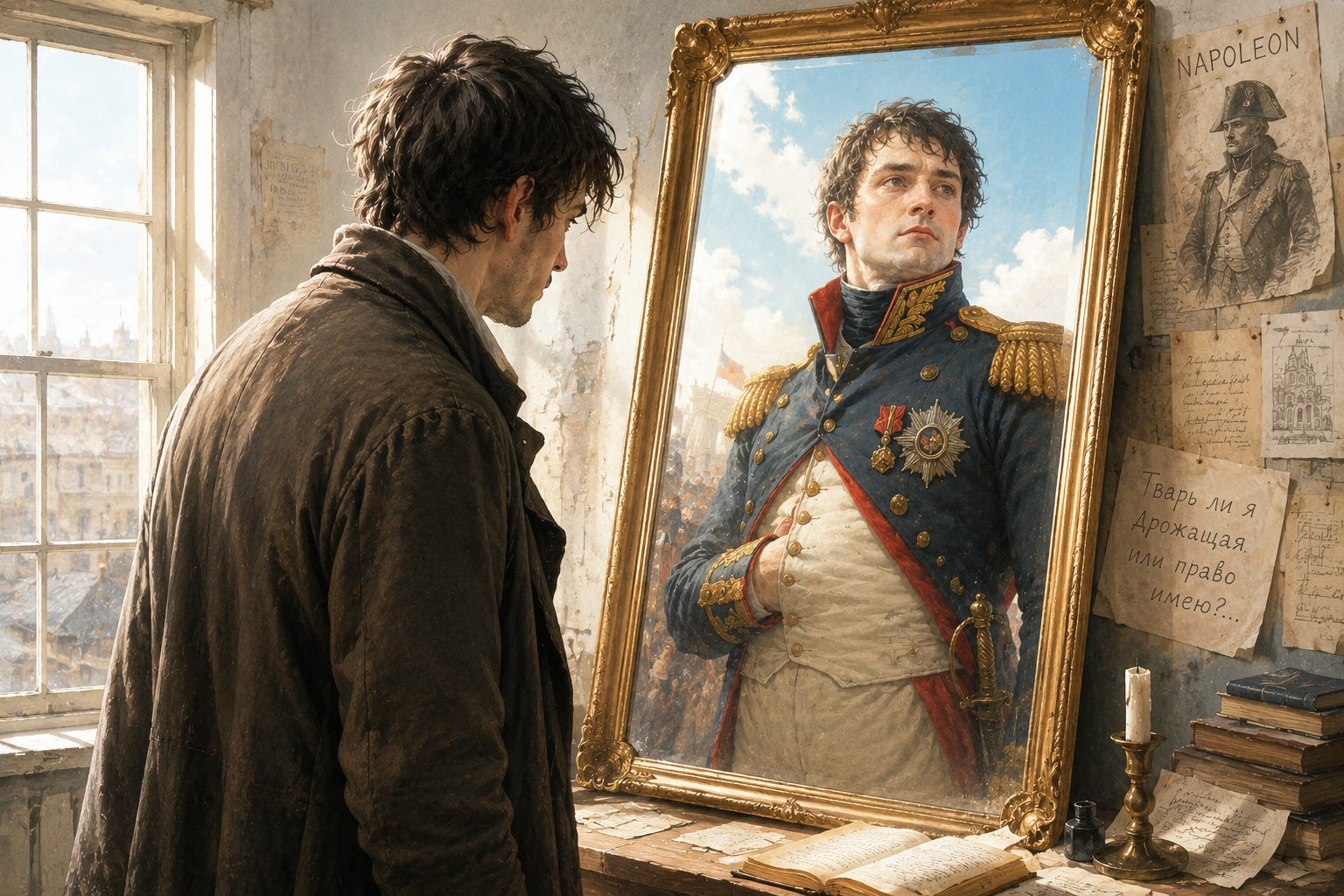
Last summer, I reread Dostoyevsky’s ‘Crime and Punishment’ for the first time since high school, and boy am I now convinced that it’s a waste to read Dostoyevsky in high school - back then, I just didn’t have the experience, the patience, the insight and self-awareness to grasp the undercurrents permeating his stories. Not that now I have a lot more of those, but enough to notice the difference in my own perception of at least this particular book. In all his books, Dostoyevsky provides a study of the human condition (I couldn’t help myself :) and he does a phenomenal job drawing psychological archetypes in his characters, showing them in so many facets that they feel both over- and under-realistic - somehow, you get to both relate to a character and wonder how on earth could anyone relate to that character, feel both compassion and disdain for them, and surprise yourself with your own reactions to the narrative. But what I feel called on to do in this little post is to explore three questions that the book raised for me upon the reread and how Dostoyevsky’s characters - specifically, Raskolnikov - correspond to them.
Question 1: What drove Raskolnikov’s definition of an extraordinary man to be imbued with a quality of transcendence of conventional morality and how did that affect him?
If you read the book, you already know that (spoiler) Raskolnikov commits the murder of the старухи-процентщицы as a test of his extraordinariness, making the murder not merely a crime but an experiment designed to determine whether he possesses the psychological qualities he attributes to great men. But how does one even come up with a test of that kind, and why would a murder reveal whether someone is extraordinary? (SN: I’ll be using “greatness” and “extraordinariness” interchangeably here.)
One way or another, we all tend to appeal to certain authority figures to derive our frameworks of morality from. So, it’s no wonder that Raskolnikov too approaches structuring his definition of a higher man by analyzing the “greats” of the past, or rather, he conducts a flawed analysis of the mentality they had to have possessed and the philosophy he believes they had to have lived by in order to truly embody their greatness. There’s a certain danger in handpicking the “greats” for your morality framework based either on the perceived correlation between their “achievements” and their (subjectively interpreted) “greatness.” The kind of danger that is probably best illustrated in the phrase “We created God in our own image” - that is, many people will see greatness where they see likeness because through shared features with the “greats,” in however small a way, they get to appeal to that greatness too. After all, we tend to define greatness in ways that allow us to participate in it. (SN: Ludwig Feuerbach was amongst the first on record to say “Man first unconsciously and involuntarily creates God in his own image, and after this God consciously and voluntarily creates man in his own image.” in his book ‘The Essence of Christianity’).
But there’s an even greater danger in assuming to know the mind of another person (what it must have been like), especially when that assumption of knowledge becomes the baseline for building one’s own life philosophy through appeal to the authority of their undeniable extraordinariness. Raskolnikov quite openly ponders that for a man to be a cause of innumerable deaths while founding his legacy, that man must possess a kind of mind that would be able to bear the weight of all those deaths, or better, to possess a kind of mind that doesn’t recognize the burden or acknowledge the weight. What Raskolnikov fails to pursue in his analysis though is what the arrival at that kind of a prerequisite in the first place says about him and his morals (he sort of gets there by the end of the book, in a painful process of taking an honest look in a metaphorical mirror). And what it says is that the higher man “possessing” a permission granted to him by his higher nature to be free of remorse and regret in his pursuits is just something Raskolnikov thirsts for and by the very act of this thirst doesn’t have, without realizing it until too late. But what’s more important is that this higher man possesses a quality Raskolnikov is not only adamant about but also, at that point in the book, actually expects himself to have (just hidden deep down) - after all, very few would have thought up a higher man that they can’t see themselves as embodying. If anything, there’s quite a neat cautionary tale here about the dangers of defining greatness/superiority in terms of qualities, characteristics, and descriptors one believes himself to already possess or be capable of possessing (SN: Yes, I’m talking about you, my lovely lovers of classics who believe that this love places you above other readers, or dare I say even non-readers :))
Anyways, is it that it’s simply unfathomable to Raskolnikov that anyone might be capable of doing the deeds leading to notorious greatness without crumbling under the weight of the “costs”? So, he convinces himself that something else must be at play, a characteristic that would allow for that. Raskolnikov is hung up on (his perception of) Napoleon’s unperturbedness while leading wars that cost thousands of lives and taking plenty of those lives personally, and he further finds such unbotheredness, such lack of remorse (or possibly even lack of understanding of a need for remorse) worthy of admiration and indicative of potential for greatness (looking at it as “transcendence of conventional morality”). In all of that, it’s not too hard to see the appeal in the absence of conscience, especially for someone who’s regularly attacked by its righteous bouts, and yet the way Raskolnikov seems to express idolization for what nowadays would qualify as psychopathy is concerning, to say the least (remember that uncomfortable concern we shared for Ollivander from Harry Potter, when he praised the greatness of Voldemort’s endeavors - “terrible, yes, but great”).
What else comes up here is the parallel between Raskolnikov’s higher man and what Ayn Rand considered a perfect human. Specifically, Raskolnikov regularly emphasizes the “innateness of greatness” - one can’t become great by seeking to become great - rather, one recognizes his own greatness, embodies it, steps into it, and it self-fulfills - which is coincidentally how Rand presents her characters Galt and, especially, Roark. It seems to be a regular iteration in her philosophy that one can’t become a Roark, rather one must be born him - the conviction that is also strongly emphasized in the journey of the character of Peter Keating, as a stand-in for someone who encroaches on greatness that he was born without (SN: Note to self - reflect on the Fountainhead). One doesn’t get to have a beautiful mind by seeking to make their mind beautiful, which then requires a beautiful mind to be an innate quality. Funny how that kind of philosophy strips away growth potential and opportunity for a lifelong change. But in relation to Raskolnikov, what seems to finally do him in is this conviction that awareness of one’s current non-greatness is an insurmountable obstacle to any future greatness because that awareness lacks a forward-looking glimpse of opportunity in favor of the self-fulfilling doom. In other words, if greatness is innate, then awareness of one’s current non-greatness becomes evidence of permanent non-greatness.
Question 2: What is a relationship between superiority and worthiness, and how is it reflected in Raskolnikov’s journey?
Raskolnikov starts his journey with a heightened sense of self-importance and through his actions (or let’s call things what they are - murder) seeks to prove to himself the rightfulness of his conviction about himself. However, very quickly he’s faced with the painful reality of not being the kind of special he hoped to be (i.e. an equivalent to Napoleon). As his delusion crumbles around him, he gets ever more defensive about his superiority, about his perception of being above other people. This defensiveness really serves as a desperate attempt at rejecting any signs of what he perceives as his inferiority to others. It almost seems that to him, being on the same level as people around him is infinitely worse than being inferior to them, but of course, inferiority still feels worse than superiority. We see this in his projections onto them, especially at the end, in prison, where he is regularly irked by his conviction that others look down on him and isolate him on purpose.
After all, it’s all too easy to intentionally self-isolate from society in pursuit of preserving the belief that one is an unrecognized genius - a self-perpetuating but never challenged narrative - to the extent that helps maintain the perception of one’s superiority, or at the very least, the superiority of one’s own values and principles.
Yet, when Raskolnikov finally acknowledges his feelings for Sonya, in that act of acknowledgement, there’s surrender of his position of self-isolation to that of one shared with another (with Sonya specifically). These acts of acknowledgement and surrender are noticed/observed by others around him, as evidenced in the reduced hostility shown towards Raskolnikov, or rather reduced projection of his own hostility that this whole time he’d been nurturing towards them. He held on so tightly to the perception of his own superiority and misplacement in society that part of his suffering was arguably fueled by his victim mentality of being an unrecognized genius. Effectively, Raskolnikov needed an appeal to the recognized authority in order to be bestowed with a kind of punishment that he could trust would provide proper retribution for his actions, and yet what he was still missing was evidence in favor of his own worthiness, of possessing value regardless of hierarchy. The notion of his insignificance gnawed at him despite all his efforts at keeping up the illusion of superiority, with his true torture being the incongruence - the deep-seated fear and knowledge of not mattering that he vehemently refuted and hid behind arrogance and self-importance.
So that when he finally acknowledges his feelings for Sonya, he’s forced to acknowledge her feelings for him too, and with that also the reality of those feelings - that he’s a creature that can be loved by someone like Sonya, someone whom he respects and whose moral judgement he trusts. And since by now, he holds Sonya in an ever-growing esteem, her love imbues his existence with worthiness because he can’t insult her by insinuating that she would love someone unworthy of that love. He holds her in too high a moral regard to suggest that she’d make a judgement mistake. And so, the more he can love Sonya and the greater regard he can develop for her, the more of an influence there is on his own worthiness by association. It can turn into a rather twisted motivation for affection and adoration, unreasonably inflating his perception of Sonya’s qualities, which in turn translates into higher expectations and an eventual greater potential for disappointment (or a more hostile approach to defending his perception of Sonya from succumbing to that disappointment). (SN: This makes me think a bit of “Phaedrus” from Plato’s Republic, where Socrates, allegedly, makes a number of arguments against the lover, including the self-serving interests that would drive the lover’s actions around the object of his love.)
Where Raskolnikov ends up is in rediscovering his self-worth in finding himself loved by Sonya - lovable to someone he’s learned to look up to as a higher representation of purity and righteousness. He starts with trying to locate irrefutable proof to his superiority and he ends with discovering his worthiness through another’s acknowledgement, which is a simplified depiction of an inferiority complex - the journey of overcompensation. But with an inferiority complex, which amusingly enough, Napoleon is frequently psychoanalyzed to have had, there’s a caution around tying one’s self-worth to someone else’s perception thereof. Dostoyevsky was a bit of a suppressed romantic (I mean ending the book with a hint of a cliche of “love will save the world, one soul at a time”), but I wonder if he really intended for Raskolnikov’s growth journey to barely have started by the end of the book. What’s curious though is that it almost feels like an illusion of progress, an illusion of spiritual growth.
Epilogue
Raskolnikov begins the novel seeking proof of superiority and ends it discovering that his journey was about worthiness all along. The irony is that these pursuits are not merely different; they are often at odds with one another. His tragedy is not that he fails to become extraordinary, but that he spends so much of his life believing that extraordinariness is what would make him worthy in the first place.
P.S. This piece is pretty much a response/comment to a great post “Dostoevsky - Crime and Punishment - A Philosophical Guide” by Philosophize This! in conjunction with my own reflections on the book. Admittedly, this is not my strongest piece structurally, so forgive me for some of the redundancy and circularity here. Also, as I was writing out the above, a third question popped up, but I’m going to just leave it here for now (seems like a bit too charged of a topic for a comment under a post): What are the parallels between fictional Raskolnikov and real-life Luigi Mangione and what does the societal reaction to the actions of the latter signal about shifts in social morality, if anything? In other words, how has the morality of murder evolved (or stayed the same) over the centuries and where are we with it now? But these are questions for another day/essay.
AI disclosure: ChatGPT was leveraged to create the image for this post, check grammar/spelling/punctuation, and help brainstorm options for the epilogue (I’m not very good at conclusions).
Originally published on Human Condition on Substack.
Join the conversation
Leave a comment
Your comment will appear after review. Please avoid sharing private information.