Human Condition · Essays
Meditation on AI in Arts
A reflection on AI in the arts, creative access, and the assumptions shaping our conversations about technology.
Recently, a scientifically-inclined friend of mine, Anara, and I had a lively discussion about AI in arts. I don’t really use labels in relation to myself (to the extent I can help it), so I won’t say that I’m an artist, but I am someone who performs, writes, musicizes, and so on. I also strongly encourage creative outlets and advocate for ubiquitous and universally accessible creativity (i.e. creativity that isn’t tied to some subjective perception of one’s creative aptitude but is rather derived from curiosity and self-permission to create). So, these are the factors of my background that influenced the perspectives from which I approached this conversation. Below is the story of what prompted the conversation and some of the points that were covered in it (you can skip Part 1 below if you’re here specifically for the discussion of pros and cons in Parts 2 and 3).
Part 1 - Inception (aka Intro)
“Docha, I want to show you a song - listen to this,” dad says, as he finds a song in his playlist and puts it on, turning up the volume so much, that the sound reverberates throughout the car. My face nearly screws up with disapproval at the expectation of an oncoming sonic offense, but I remind myself about dad’s left ear and manage to keep my face neutral. Admittedly, the song intro has a rather euphonic sound, so that even the over-the-top volume doesn’t hurt my ears, and I just nod and let the attentiveness on my face match the enthusiasm on dad’s. We’re on our way home from the airport. It’s my first visit in a few years, and we’re both re-exploring our connection with care, mindful of the length of the drive ahead of us - after all, a lot can happen during 5 hours in the same car.
The song is beautiful. The vocals are crystal clear and feel almost ethereal. I also recognize the lyrics as a poem by a modern poet that was popular in Eastern Europe a few years ago. It’s meaningful and I can totally see why dad’s so captivated by it. Although me being me, I also spotted the lines in the lyrics that could benefit from further deliberation. I Google the song and see it pop up on major music platforms and Youtube, with the comments section of Youtube being filled with similar expressions of tearful admiration shared earlier by my dad. He looks at me hopefully, “Will you learn it for me? You have similar voices - I’m sure you’ll sound good.” I pause for a moment, trying to recall when was the last time dad asked for something like that, then nod agreement. Since I write and perform songs mostly in English, dad doesn’t tend to talk to me much about singing (I guess why would he, when it’s in the language he doesn’t understand). So I might be a little too eager to comply with his request at this unexpected acknowledgment of my vocal potential.
Almost as soon as I’m home, I get to breaking down the song to study it. And right away, I’m both puzzled and frustrated: the rhythmic signature of the song shifts without reason, and the chord progressions are all over the place. It feels like the melody was force-fit into the text, without logical adjustments to either. And yes, I am all for breaking music rules and creating something new and unexpected, but the disregard for music rules in this song just irks me. I take a break from my musical vexation to chat with aunt Valya, our local handywoman, who’s really more of a Jane-of-all-trades (and no, we’re not related - it’s just that in Kazakhstan, we use “aunt” and “uncle” to refer to people older than us with familiar formality or formal familiarity - your choice).
“I wrote a song!” she shares eagerly.
“That’s amazing!” I express my excitement, simultaneously scolding myself mentally for not remembering anything about her musical interest.
“Well, I wrote a poem, and then I used this app that turned it into a song - let me show you!”
I hold my breath. I’m not even sure why I’m holding it. I want to be supportive - after all, creativity in general has way more stiflers than supporters, and I strive to ameliorate that - so I find myself a bit discombobulated by the sudden feeling of apprehension.
The song is quite lovely. The vocals are crystal clear and feel almost ethereal. My yet-untrained-for-AI-vocals ear wouldn’t have singled them out as non-human. There’s a bit of a broken rhythm here and there, as the app was obviously trying to force-fit the music into the text. But what really gave it away was the app’s incorrect treatment of the third stanza of the poem as the bridge - the vocal build-up was so out of place with the text that it sounded almost comical. It wasn’t my place to criticize though, so, in my feedback, I just focused on the human element of the piece - the lyrics, which were quite personal and splendidly sentimental.
I turn to go back to my task of learning the song for dad and halt in my tracks. Crystal ethereal vocals. Broken rhythm. Force-fit melody. No WAY! I hurriedly do a quick investigation: extremely limited credits in the song credits section of Apple and Spotify; barely anything across all of Google about the artist; the vocals sound almost identical to other confirmed AI songs on Youtube. I have a quick call with a rock-singer/vocal-coach friend of mine, and she confirms what I’m sure you’ve all already guessed - yes, the song is indeed AI-generated, and most people in the music industry know it, but the rest of the general population are blissfully (blindly?) ignorant.
The scary part is that just about a year ago, while recording one of my songs, the sound producer, who also happens to be a good friend, and I were laughing about the ridiculousness of some of the AI song outputs that he was playing around with. We concluded with a note of relief, “It’ll be years before AI manages to mimic anything close to the emotionally-charged singing that is capable of capturing the depth of human experience!” Little did we know that in a matter of a single year, there will be AI songs that people cry to (but really, we should have known better than to underestimate the exponential rate of change intrinsic in AI).
Part 2 - A Few Positives (aka Verse 1)
“So, what is your take on this?” Anara asks.
“That’s the thing - I feel conflicted,” I semi-laugh, “And here’s why.”
1) First of all, I have to acknowledge - AI offers exciting opportunities for a lot of creatives out there! For example, many poets have dreams about pairing their poetry with another art form, such as turning their poems into songs. Just a few years ago, this meant they had to find interested (and affordable) musicians, singers, sound engineers, and then some, likely going through a few rounds of trials, aka “first dates,” with different professionals, until they discover the “match.” Then they had to collaborate with these professionals, usually asynchronously, often over the course of at least several months, to realize their vision for the song, with a lot of back-and-forth, reviews of numerous drafts, exchanges of feedback, etc. Trust me when I say - it can quickly turn an exhausting process that sucks all the joy out of its creative undertones. The same applies to musicians looking for song lyrics, or writers looking for illustrations to represent their writing, or illustrators trying to come up with stories for their images, and so on and so forth. It’s always the same asynchronous dance peppered with annoyance and frustration - I mean have you ever tried dancing with someone, while each of you is listening to a different song? Sure, it can be a fun challenge, and yet I trust you know what I’m getting at here.
2) So, it’s no wonder that when AI tools/apps swept in with their sweet offerings of real-time updates (goodbye, asynchronicity!) in addition to promises of no emotional discomfort that arises from differences of opinion or resentful reactions to feedback, they received a rather warm (even if initially suspicious) welcome. I mean imagine, you explain your vision to AI and it actually asks clarifying questions, helping you polish the explanation or even better understand what it is you want. Then it creates a draft of your idea within minutes of your pitch and updates it immediately based on your feedback. And you don’t have to worry about hurting its feelings when it completely misses the mark. Who wouldn’t be tempted? (Maybe, extreme extroverts?) So, yes, one of the biggest opportunities of AI in creativity is its contribution to the development of accessible cross-functional creativity.
3) Furthermore, as someone, who seeks to encourage others to give themselves the permission to explore their creative drives, I also see the potential for the empowerment of general population to tap into creativity outlets that arises from AI tools/apps. I have now come across a number of people, just like aunt Valya earlier, who in AI found support and encouragement to venture out into previously inaccessible fields. I mean who am I to be the creativity gate-keeper and negate the fulfillment and excitement with which these people approach and share their creative endeavors, even if a significant portion of the creativity there is executed by AI? To write a poem or a song with AI, one must already start with some curiosity and interest for poems or music. And while it would be much preferable that these people discovered the joy of creating their own art, let’s get off our high horse (yes, the self-acknowledged creatives, I’m talking to us) and acknowledge that most of the general population would likely never attempt that even without AI. So them engaging with poems and songs even through AI might actually be a better outcome than them not engaging with them at all.
Part 3 - A Lot More Negatives (aka Verse 2)
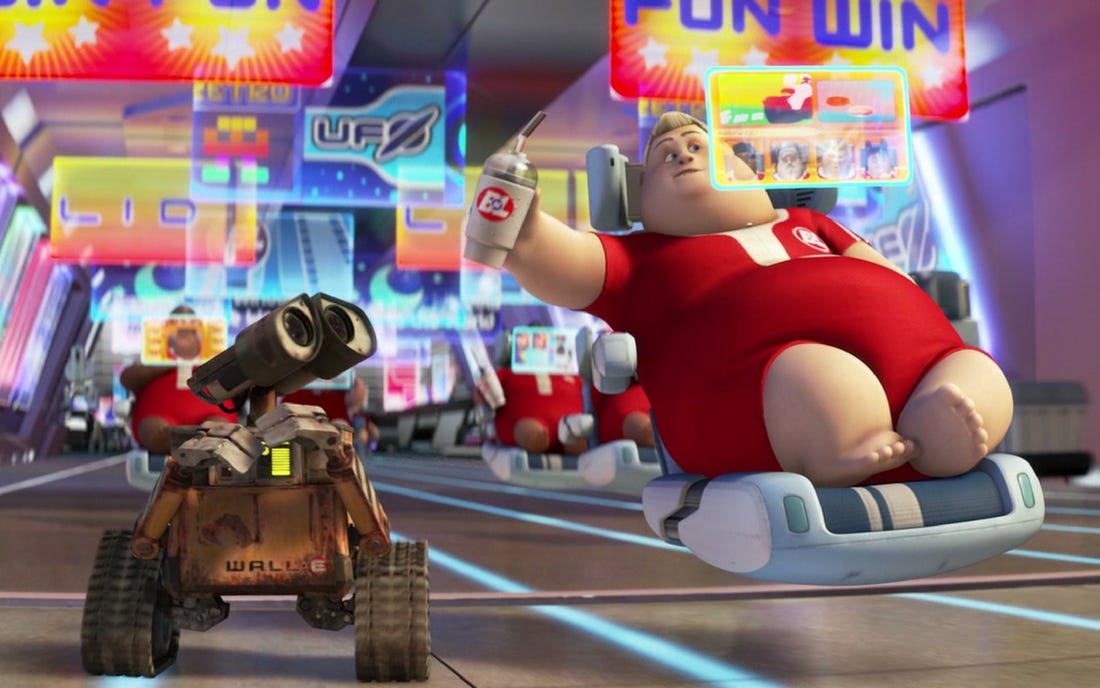
1) Well, I will have to also be the first to acknowledge that this whole “AI in Arts” thing is loaded with hidden (and not so hidden) pitfalls. Let me start with the most obvious one - creativity is a human domain. Or at least, it was supposed to be. The initial promises that stood behind AI were that it would take care of the mundane tasks, freeing us up to engage more with those that rely on the unique organization of the human brain - from our capacity for metacognition to opportunities unlocked through associative thinking, or in other words - to think and to create. If we outsource that to the AI as well, what will remain for us? Utterly unadulterated consumption? Is that the future that Wall-E tried to warn us about over a decade ago?
2) Here’s a less obvious one, but the one that creativity aficionados might care about the most - by replacing human collaborations with AI (e.g. using AI to create an illustration for your book rather than working with a human illustrator - full disclosure, adding the qualifier “human” there feels eerie, and it feels even more eerie that I need it there), we lose the creative expansion that comes from the cross-pollination inherent in creative collaborations. Yes, working with other people isn’t always easy, but it allows us to discover new perspectives, learn different/alternative ways of doing things, come across happy accidents that go on to become collaborative masterpieces, etc.. If AI is just another reverberation of your own voice in the echo chamber inside your mind, then cross-creative collaboration is an opportunity to explore the orchestra within the “confines” of the universe. Let me use the most cliche metaphor there is to clarify. Ideas and visions inside our minds are caterpillars. AI takes those caterpillars and turns them into bigger (and probably prettier) caterpillars. But it is through interaction with other (human) minds and perspectives, that the caterpillars of our ideas and visions can undergo a true metamorphosis. (Okay, I will acknowledge here that it is okay to feel resistance towards subjecting our caterpillars to the metamorphosis, since we might be too attached to them in their original form to see them transform or we might feel too strongly about the ownership thereof to let our degree of ownership get diluted, since we might not wish to share the credit. That’s all alright. And yet, chances are that the longer we live, the less we will care about the credit and the more about the process of exploration and discovery.)
3) Now, for someone like me, who’s extremely interested in the idea of enhancing human connection through effective communication, this next point cuts deep. Favoring AI over engagements with human creatives (brrr, that eerie feeling again) can lead to degradation of our communication and collaboration skills. We’re all familiar with the good old “if you don’t use it, you lose it,” most commonly applied to foreign languages. If converted to “when you don’t use it, it grows rusty,” it can be applied to a wider range of cognitive matters and general skills, but especially communication. We think in various combinations of words, images, and fleeting sensations, which can mislead us into being convinced that our ideas and thoughts are clear. It is only when we attempt to convey them to others that we discover all the little (or big) gaps in those ideas. For example, imagine a “butterfly” (I know - what’s up with me and butterflies today?). Now, describe it to someone else in detail. Depending on how well-practiced your communication skills are, you might get the idea - chances are, it won’t be easy to paint the picture inside your head with words. But if you engage in a daily practice of describing this butterfly (especially if to different people), you’ll discover better and newer ways of creating the image outside of your mind. (Full disclosure - that’s mostly why I am on Substack - learning to articulate my thoughts)
4) The reduction in our communication and collaboration skills can naturally lead to reduced interactions with other people and engagement in collaboration (reduced willingness to collaborate), which then increases the likelihood of the feelings of loneliness and isolation. The comfort of AI company can be intoxicating at first, but just like social media followers aren’t equal to friends, AI company offers little nourishment in form of authentic human connection.
I am convinced that the harder we find it to articulate our thoughts, ideas, and vision, the more we need to practice doing that. Yes, we all know that it’s often more important to focus on our strengths and manage our weaknesses through delegation and what not. However, I seriously doubt that weaknesses around communication should be subjected to the same approach. Let me go on a quick tangent here. Have you heard of Liebig’s Law of the Minimum (aka the law of the weakest link in a system)? It argues that “a system’s total capacity or strength is determined solely by its weakest component, rather than its strongest.”
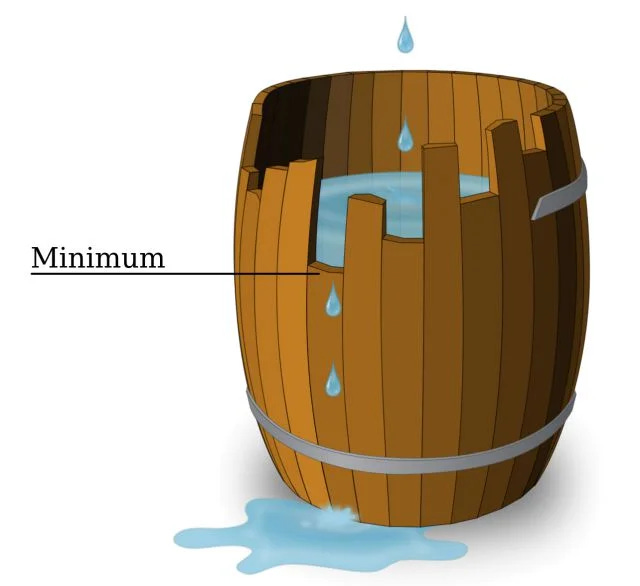
Now, yes, there is plenty of exceptions to this statement, and it’s definitely more of a theory rather than a law, but that’s really not the point: I am convinced that the weakness or strength of one’s ability to communicate and collaborate with others actually will more often than not be the determinant of one’s capacity - capacity for success, capacity for happiness, capacity for a fulfilling and fulfilled life. We’re inherently social creatures, and we’re already observing severe repercussions to our mental health and general life satisfaction arising from our diminishing ability to communicate. After all, it can turn into a bit of a vicious circle: struggling with communication and collaboration, we can now just isolate ourselves from the discomfort of figuring those skills out and avoid working on them altogether, thanks to AI, which not only doesn’t address the underlying issue but exacerbates it further because with less and less practice, those skills will grow less and less refined, the discomfort from occasionally having to rely on them will increase, which will serve as further rationalization for self-isolation, and so on.
Some might argue, “But I do communicate with AI - why would that not count towards this practice?” Fair question. Simple answer - for the majority of average AI interactions, it just does not. AI is a tool. The way we interact with it, while might be polite and friendly (but to be frank, most people are not going to be polite and friendly in those exchanges), still does not allow us to experience the complexity and nuance that interacting with a real human being would. Worse yet, because of how most AI interactions don’t treat the AI as a living and breathing thing, the way we habitually engage in these interactions can then start “infecting” our normal conversations with similar detachment and even insensitivity. I know this is a bit oversimplified, but if this part of the conversation creates any resonance, I’m happy to expand on it and address it properly.
5) Finally, and this is one of the simpler cons - the abundance of AI-generated arts simply suffocates the human content. Before AI, there was already about 6,000 books getting published daily (making it ~2.4 million in a year) and about 120,000 songs getting released every day (~45 million songs a year). Imagine those numbers now, that AI books and songs are flooding the creative landscape! Human creations simply drown in this “abundance of supply” & unpredictability of algorithms! It’s like trying to locate truly nourishing food amidst the biggest ever fair of fast food content, day in and day out. Oh, our poor starving bodies, minds, and souls!
Part 4 - Now What? (aka Bridge)
Of course the list of pros and cons noted above is far from exhaustive. And don’t get me wrong, I’m not here to demonize AI, but I am here to advocate for awareness of potential consequences of AI over-indulgence and discover and promote its sustainable use. Universities, along with all the affected fields, such as writers, musicians, psychologists/therapists (trust me on this one), and others, should stop with their hands-off AI-prohibition crusade and dedicate that energy towards developing guidelines for and teaching sustainable approaches to using AI. It might be a bit of a stretch, but I’m going to go out on a limb here and compare this to sex ed for teens - we can prohibit teen sex all we want, but it will still happen and these “sexually uneducated” teens (yes, the wording is cringy, but do give me a pass on this one or suggest a better alternative) will be more likely to suffer from sex-related “issues” than their peers that got at least some instruction. A ban on AI use in certain fields and areas may be quite desirable (trust me, I get it), but let’s be real here.
And while the intelligent ones (hopefully) gather at the Mount Olympus for deliberation and brainstorming on the above, here’s a few things I’d like to see put to action as soon as possible:
To any AI-user out there - please understand, clarify, and be honest with yourself about your objective for using AI. Ask yourself “Am I outsourcing my thinking/creativity, and if so, what’s the point?” (and if you are, maybe make a personal pact of journaling for 5 minutes on the subject you’re outsourcing, so that you’re at least partially making up for the lost opportunity to think/create).
To any AI-arts-creator - please find it in your heart to include ethical disclosures of the extent of AI use in your works. I know right now AI-generated-art is not exactly acceptable, so you might feel the need to hide its nature, but I’m sure your credibility will take a worse hit from subsequent discovery of AI-use rather than upfront disclosure.
To Spotify and other music platforms - please take responsibility for better monitoring your catalogues for AI content and address the currently existing loopholes. For instance, song covers and remixes require certain procedures and disclosures - that should be the case for AI songs too. At this time, it’s much (much) harder for me to report an AI song on Spotify than for somebody to upload it to the platform, and that’s not a good sign.
To creatives who take pride in the humanness of their art - please invest in your organization (AI can help:)) and communication/collaboration skills to mitigate some of the noted reasons people might flock to AI. After all, our artistic/creative integrity is easier to maintain when there’s fewer external attacks on it.
To everyone - please remember, as Brandon Sanderson put it, “The process of creating art makes art of you.”
Part 5 - Outro
My brother Romallito (pseudonym) has been developing quite a bit of familiarity with various AI tools - recently, he used them to restore some of our dad’s old photographs and even turn them into videos. Dad’s reaction was absolutely priceless! He has used them also to create marketing campaigns for his business, as well as to research complex topics to self-educate. And his most recent exploration in the AI space took him to the songwriting tools. When he sent the first AI-generated song to our siblings chat (there’s 5 kids in our family), my sister Karrality (stage name), who’s in school for music production (and is an accomplished singer/songwriter herself), noted, “It sounds nice, but I just don’t know what to say about an AI song…” “It was so easy to create!” Romallito added. “Yeah…” was Karrality’s (and mine) defeated reply.
Because here’s another conundrum - how on Earth do you compliment an AI-generated piece of art? An AI song or an AI image? With something like “I can tell that you’ve come up with a really great prompt for it to produce this”? The way we compliment human creative output (the eeriness is wearing out, and now that’s eerie too) usually takes into account the recognition of the thought and effort that went into the creation, the appreciation for the way another human mind sees the world and is able to share that vision with us, and the connection that results from the feeling of being understood/seen/heard/reflected by another person through their art. How in the world can we apply any of that to AI-generated art? I don’t have an answer to this one yet, but it would certainly help me to know the elements of the AI output that belonged originally to the prompt-writer, so I can at least appreciate that aspect of it.
P.S. I did learn the song from Part 1 for my dad. It sounds different with the guitar, less euphonic, and my voice is far from having that crystal ethereal quality, but I infuse every word with the meaning of my lived experience, and I perform this song to connect with people, which is really all that matters to me. Also, Romallito recently used AI to create a personalized birthday song for our cousin, and it was actually quite sweet, so…
P.P.S. I have a few more thoughts/perspectives I’d like to explore/share on this topic, so stay tuned :)
P.P.P.S. Here’s the link to the song (although I also implore you to balance out the algorithms by listening to real human content afterwards - this AI song has already attracted too much attention, so feel free to check out my music or my sister’s music for the sake of balance). And here’s the AI translation (with my edits) of the poem-turned-song-lyrics (admittedly, they sound better in Russian):
There stood a line for happiness, where miracles were up for sale.
They even traded greed itself - the stock was gone in half an hour.
Love could be bought by those in love; if you have money - every whim’s for purchase.
The divorced can buy their freedom back, a singer pays for wreaths of fame.
At the market of souls, at the fair of fates, everything’s for sale - choose what you will.
Someone will get their happiness here, someone will find their heaven.
At the market of souls, amongst noise and jostle, price tags hang on every thing -
Only conscience, dusty on the shelf, is something no one wants even for free.
Women stood in line for tenderness - not stood, but pushed their way right through.
A long, long line for outer beauty, a much shorter one for intellect.
They sell arrogance there as well; men, too, are far from innocent:
For women’s trust and confidence, they paid with pitiful small change.
The talentless chase after glory, talent today is on the cheap.
The cruel smile rapaciously, leaning on someone’s faithful shoulder.
Through noise and commotion, they purchase there rights, diplomas, cars, and lies.
They shove each other for hypocrisy; only conscience draws no crowd.
Only for conscience, no one comes.
AI-use disclosure: I used Amadeus (my ChatGPT) to do a final spot check for grammar, spelling, punctuation, and syntax issues.
Originally published on Human Condition on Substack.
Join the conversation
Leave a comment
Your comment will appear after review. Please avoid sharing private information.