Human Condition · Essays
Ode to Hope and Despair (The Book)
A look at how personal poems became an illustrated book, with lessons from editing, collaboration, and publishing.

Tomorrow is March 30, which is a special day for me - the first birthday of my beautiful book! So, in this post I’d like to 1) tell you a little about the book and 2) share some tips from my own writing and publishing journey that might come in handy for other writers out there.
(SN: All tips and strategies are pre-AI popularization.)
About the book
Book’s Journey: The Birth of The Concept
Book’s Journey: Editing
Book’s Journey: Illustrations
Book’s Journey: Publishing
Book’s Journey: Promotion
How to Read The Book
Outro
1. About The Book
OtHaD is a beautifully illustrated collection of thematically organized poetry and prose written mostly under the influence of my darkest hours, spent at the bottom of a dungeon created by my own mind. However, even in the depths of the abyss, I still caught glimpses of the stars, which had to shine brighter than ever to pierce through the dense darkness. And shine bright they did.
After all, what is Despair if not Hope through the looking glass, and what is Hope if not Despair reflected in a funhouse mirror? Where there is one, there will always be the other, just a foot away, ready to take over at any mis-step/right-step. And life is but a continuous attempt at a fine balance.
I have spent years building up shells of fake identities to fit into the world I thought was not for me.
Now, by means of writing, I’m peeling away layers of this shell and, instead of trying to be part of the world, I finally let the world become part of me. I don’t need to wait for my life to be free of depressive episodes to start living. And recurrence of those episodes doesn’t put my life on hold. It’s all part of it.
Someone asked me once, why I even wanted to invest my energy into this book, into something that focused so heavily on the old negative feelings that I should have long left behind. It was suggested that maybe instead of keeping myself in that old rug, I should be focusing more on where I am now. The assumption, of course, being that where I am now is far away from the “rug.” It was a flawed assumption though - it’s not that I deliberately keep myself in “that old rug” but rather that I learned that the rug was a part of me all along - all those vulnerable and hurt parts - and denying its existence stood in the way of true self-acceptance.
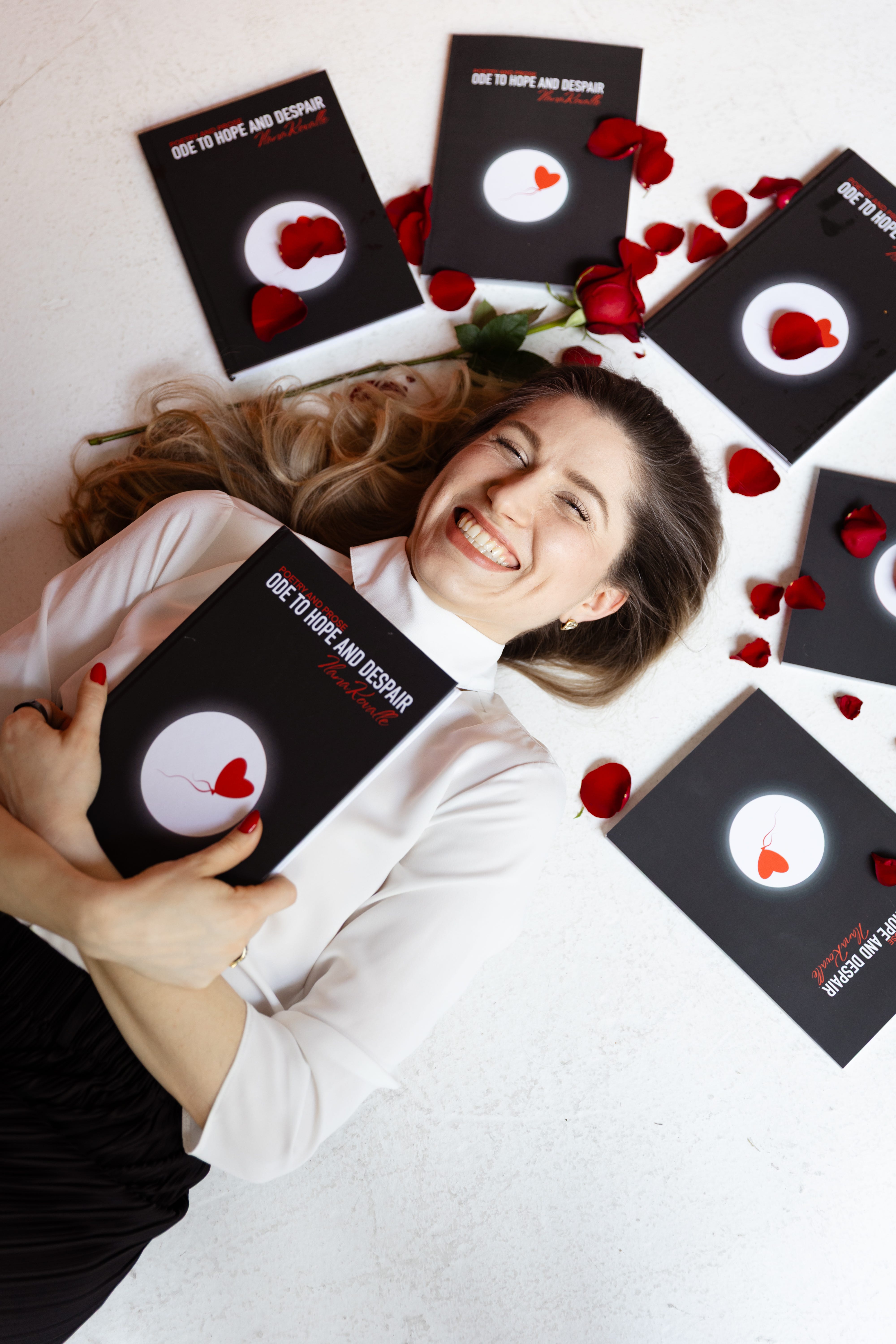
The book starts off with black pages and white font, and over the course of the reading, it progresses to black font and white pages. Quite a literal journey:) The book is so visually striking, that I won’t hold it against you if you buy it for the illustrations alone - after all, my illustrator did a magical job helping me bring my vision to life.
(SN: When looking at the proportion of dark vs light pages, it might strike you that there’s more “darker” pages, but that’s part of the curious way we perceive shades, which can be a metaphor on its own: we tend to ignore the tiniest shifts in shades until we look back and compare the current one to where it initially started, forgetting that there’s beauty in every gradient that stretches the path from despair to hope. Furthermore, if we look at a color spectrum, from black to white, we would generally only assign the classification of “light color” to the latter 20% or so, thus choosing, subconsciously, to interpret 80% of the spectrum as pertaining to dark colors - how is that for a negativity bias?)
I’ll let you in on a little secret: first and foremost, I wrote this book for... me. Yes, I know - outrageous! Well, I am an egotist (an honest egotist, may I add:))
Shaping my feelings into poems (and occasionally song lyrics) was my way of processing them, separating them from myself, so I could look at them from a bit of a distance, so I could honestly say “My feelings are me, but I am NOT my feelings - I’m so much more than that.” It was also my way of attempting to share with my friends and family what was happening inside my head - simple words didn’t suffice & it’s hard to maintain connection when a big part of you remains unknown or un-understood. I illustrated it for myself too - the idea of bringing my vision to life with those black-white-red images felt invigorating and the kind of challenge that excited me to the core.
But I published it for you.
For those of you that shared how my writing and metaphors resonated with you & helped better articulate, understand & navigate your own experiences.
For those of you that are yet to experience the cathartic release through vicarious experience of your feelings in another’s words. It’s quite a satisfying scratch to that habitual brain itch, if I say so myself.
In the end, Ode to Hope and Despair is both for those going through dark days & for their loved ones - to provide hope to the former & insight to the latter.
This book was published to help the former become more familiar with their own mind and help the latter better understand the mind of the former. Because there is quite a bit of relief in the knowledge that someone else is going through a similar experience, that we are not alone in our struggles. And I wanted for you to feel that non-loneliness too.
Depression grows its largest fangs when lurking in the shadows of rejection to which it has been exiled. So, the normalization of it as a widely shared experience that can and should be openly discussed is a way to cleanse those shadows with light and fire.
After all, this book is not just about a life permeated by depression - it is also about the struggle to not be defined by that depression, or even by that struggle. It is a lesson in learning to accept all facets of oneself and watching how through that acceptance they begin to transform into something once unimaginable.

2. Book’s Journey: The Birth of The Concept
I had written about 85-90% of the pieces in the book over the course of a few (rather depressed) years in my early 20s. I kept most of my writing in Evernote, but it was starting to get a little overwhelming to navigate, so I decided to combine it into one document. That was when I spotted a theme in the pieces and arranged them accordingly - from darkness to light. Almost immediately, I had a visual for the book - black pages gradually turning to gray to white, over the course of the read, with illustrations all done in the tricolor of black-white-red.
In my mind, it looked beautiful and also... a little too far-fetched, unreachable. Why did I think I even had a right to try to create something like that. After all, I wasn’t really a writer, since “writer” is someone who’s already written & published books, right? And only writers were allowed to think about writing and publishing books... (Catch 22, anyone?)
Then, during the pandemic, I came across two inspiring writing courses, which turned out to be fateful: One was “Poems That Don’t Suck” by Megan Falley, which introduced me to some incredible poets (and also my lovely editor Melissa Sussens) as well as snuck me backstage of the writing process and expanded my capacity for poetic expressions. It also left me with 5 new poems for OtHaD. Is there any wonder I took that class twice?
The other was “Writing and Publishing Mastermind” by Larisa Parfentieva, which not only connected me with passionate and driven women-writers (and my multi-talented illustrator), but also helped me believe that creating and publishing my own book was actually quite possible.
I could say «the rest is history» but it wouldn’t do justice to the journey that only started when I gave myself permission to not just believe that I could one day publish a book but to start calling myself a writer even before I did that. After all, a writer is just a person that writes. It doesn’t need to be more complicated than that.
3. Book’s Journey: Editing
You know what’s nearly every writer’s nightmare? Yep, the editing process (EP).
It’s so numbingly iterative and comprised of so many levels that it can quickly turn into an ill-fated bee that stings the elephant of one’s writing ambition straight in the eye.
This editing nightmare bee-came one of the reasons why my book didn’t see the light until 2025, even though its first draft was ready in 2019. I dragged my feet, arms and every other part of my body, resigning to work on all sorts of other projects just to avoid the editing. I mean, I wrote drafts of 3 other books just not to edit this one. How about that for a procrastination strategy?
Speaking of procrastination. You might know that there are 3 common reasons we procrastinate: the task is 1) unclear, 2) boring, or 3) too large. Now guess how many boxes the EP checks off?...
Anyways, things started to turn around when I joined aforementioned writing courses, where I learned some helpful tips for taming the EP bees and even developed my own 8-step approach to it (works best for poetry books - my EP for longer narratives is a little different).
Identify and affirm the book’s central theme.
Create an initial layout/flow of the pieces based on the theme.
Print it out (yes, on paper - trust me on this) and go through it high-level to check how the pieces flow together.
Re-arrange as necessary (paper copies help with this) and remove any pieces that don’t fit (if you’re like me, killing your darlings can be hard, so just cut and paste them into a separate doc for potential future use).
Establish a timeline for editing to help with accountability (I strived for 5-10 poems a week).
Clarify your editing goals/focus for each piece - what’s already strong about the piece & what shortcomings distract from that strength?
Message-theme-structure
Rhyme and/or rhythm
The world of the poem and its vocabulary
Metaphors/similes
Line breaks & punctuation
Once you’re done with your own edits, get an editor and work on their feedback.
Print out the final manuscript (yes, again) and give it a thorough read-through checking for
General flow and adherence to the theme.
Grammar-spelling-punctuation
Do you have any EP tips/tricks to share?

4. Book’s Journey: Illustrations
As I mentioned, the vision I had for this book - the tricolor of black-white-red with pages going from black to white - existed before I even contemplated the idea of publishing it. It was more of a “would be nice” fantasy rather than any real plan. Until I shared this vision with my fellow writer Tanyusha who was also an illustrator.
I’m sometimes asked about how I pick collaborators for my projects (from sound engineers to editors) and the answer is - by trial and error (and personal spark). But the main factor is how they connect with my vision - no matter how amazing of a professional you are contemplating to collaborate with, if they are lukewarm about the project, the collaboration will be a drag.
Needless to say Tanyusha expressed such fervor about my idea that it rekindled my own ardor for it.
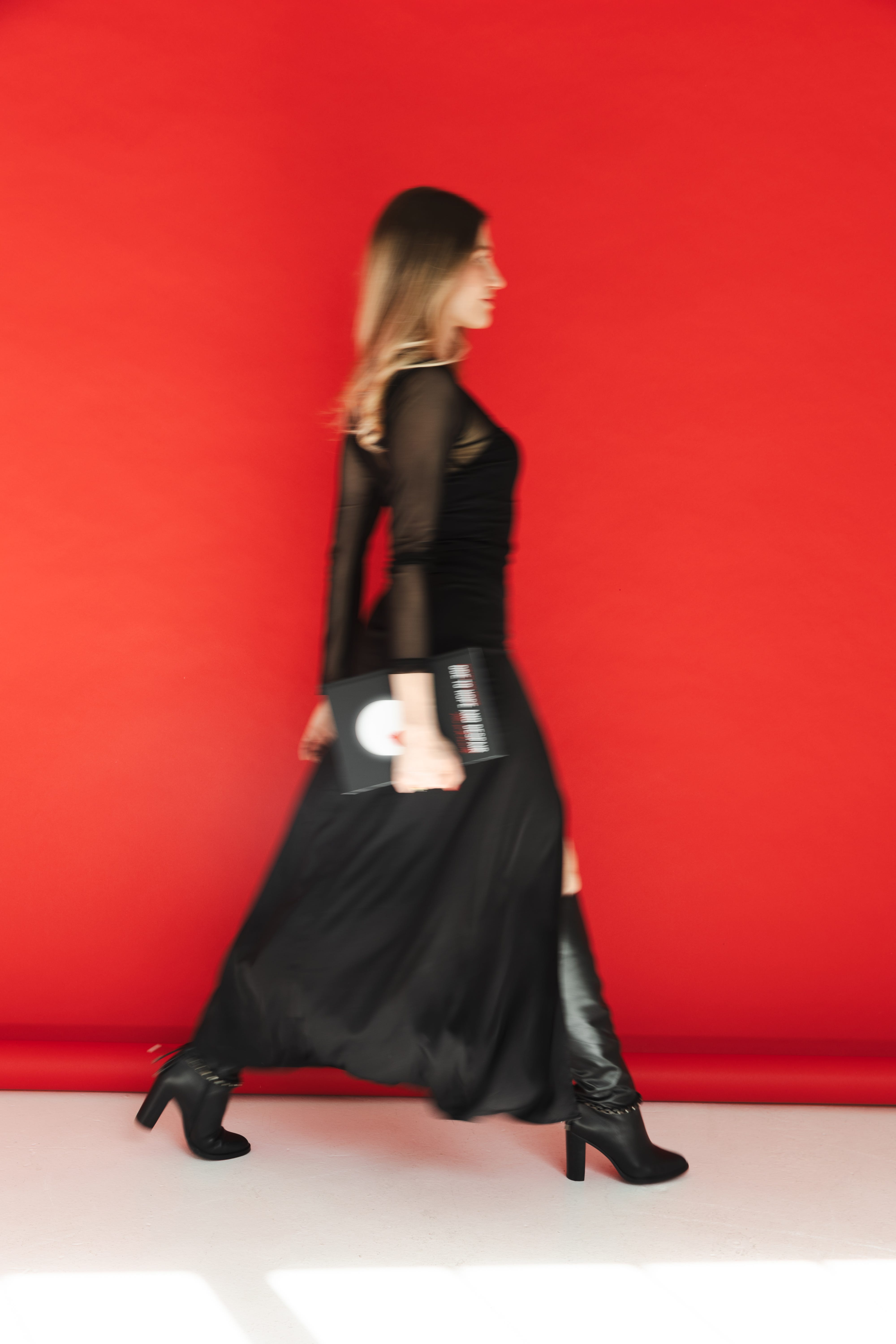
(SN: A more recent example of such immediate connection was with the wonderful photographer behind the photos in this post - dear Sofi’s enthusiasm for the black-white-red book photoshoot matched my own and I immediately knew I wanted to work with her.)
What caught me by surprise though was just how much work went into fully illustrating a book: I myself had to come up with all image ideas for every single piece in the book (which is over 100), describe them, find and provide references, share feedback on the drafts, and keep track of it all. I ended up leveraging Notion as a tool to keep me organized - all descriptions, references, drafts, comments and status were shared through it.
Something that also goes under-appreciated in artistic collaborations is the period of calibration between the artists - it can be quite a process (often months-long) to learn to really understand each other and get on the same page (and language). So, when it comes to artistic expression and interpretation, I’ve thus learned that
It takes time and practice to accurately relay the conjurings of your mind, and
The communication gap is real and should be respected (after all, when I say “butterfly,” your mind’s image differs from mine, and that’s okay).
Based on those takeaways, I also discovered the three principles on how to approach the calibration period without letting it tamper with the relationship with the collaborator:
Expect the communication gap and calibration period and account for it in your timeline,
Overcommunicate
Remember that intention is usually positive (that is, trust me - your partner is not purposefully trying to irk you with misunderstanding).
What’s been your experience with collaborations? Any tips?
5. Book’s Journey: Publishing
I have a random theory that Brandon Sanderson came up with his famous ideal of Journey Before Destination (JBD) during the years he was writing without an agent - because book publishing (with its pitches, queries, and rejections) can quickly become grueling (and ungrateful), so focusing on the process over results is crucial.
In this context, the JBD ideal can look something like this:
1) “Writing Before Publishing” (duh) - writing for the sake of writing, regardless of whether it’ll ever be read (because I love it and it’s part of who I am - pretty sure that Brandon would approve).
2) “Publishing Before Selling” - focusing on taking one step at a time, regardless of how many copies might get sold.
Using the JBD perspective in “Publishing Before Selling” is harder because publishing a book is like giving birth to a child. So the lack of sales then can feel as if the world is shunning and ignoring this beautiful child of yours - few parents would be unbothered by that kind of public “bullying.”
Speaking of kids. You know how the first kid is often a “test” kid? It’s this grand experiment in parenting during which parents learn all the “mistakes” to not repeat with subsequent kids. I’m the eldest kid in my family of five - trust me, I know (my parents even acknowledged that). Well, I didn’t want OtHaD to be my first child, so I decided to have a sacrificial book and learn the ropes of publishing with it. Although, despite being the first child, that book - LOML - turned out to be remarkably okay:)
After LOML, I knew I needed to pay extra attention to the cover image, margins, key words, and buying my own ISBNs (unique book IDs) in order to not be limited to Amazon. I also knew I was ready to delegate some of that work, so I hired a book interior designer (yep, turns out it’s a thing) to put the illustrations together with text in the color, margin and print format acceptable by publishers. Then I uploaded the files to Amazon KDP & IngramSpark for on-demand print of paper copies and to DraftToDigit for ebooks and scheduled the release. Just like that.
(SN: Do you dream of publishing a book but don’t know where to start? I’d be happy to support you & share what I know!)
6. Book’s Journey: Promotion
You know how I said earlier that editing is practically every writer’s nightmare? Well, that makes promotion and marketing (P&M) a true night terror. It’s a tug of war between finding self-sufficiency in writing for the sake of writing and being a proud book parent that wants her baby to be welcomed by the world.
“But Ilana, why even bother promoting - a good book (or song) will sell itself!”
Mmm, sure, but…
Did you know that about 6000 books get published every day, making it ~2.4 million in a year? The stats are even tougher for songwriters: ~120000 songs get released every day, making it ~45 million songs a year. (SN: These stats are even before AI hijacked those two fields.)
Our creations simply drown in supply abundance and unpredictability of algorithms! Now, don’t get me wrong - it’s quite amazing to live in the world where so much art gets created every day! I’d just like for my literary and musical babies to have friends:)
So I took a deep breath, made a list of tasks, divided them up by weeks and months, and ventured out into the turbulent waters of P&M. Funny enough, my corporate audit job equipped me with skills for this kind of planning and strategizing (#grateful).
Here’s some items from my own P&M checklist (but I suppose that ChatGPT could give you something much better at this point):
Create an author page on bookshop.org, Amazon & Goodreads
Plan social campaigns (posts/reels) on #Bookstagram and #BookTok
Use book giveaways to invite reviews on Amazon & Goodreads
Make a list of, reach out with your pitch to, and create a calendar schedule out of
Library/bookstore events - offer to read/speak as a local author, host a book presentation/release event, bring a few book copies for consignment sales
Book fairs/clubs - apply to participate but attend a couple first to get an idea
Open mics - read pieces directly from the book or host your own readings
Relevant contests/submissions and literary podcasters
Book/poetry reviewers - reach out and offer free book copies
You don’t have to engage in all these strategies - just pick one that causes the least resistance and play with it. You never know which little step will take your creation the closest to its target audience. Just remember: it says nothing about your quality as a writer/creator if you don’t sell anything - good writers are rarely great sellers, and that’s okay.

7. How to Read The Book
This book is a journey, but nobody said that the journey has to be linear. So here are a few options for how to read Ode to Hope and Despair:
Option A - flip through the pages, find the illustration that speaks to you, and read that piece (good for anyone anytime).
Option B - focus on the lighter pages in the last third of the book (can be good for lighter moods in general and also for lightening the mood if necessary).
Option C - explore the darker pages in the first third of the book (can be good when in need of an emotional release, trying to put feelings into words, or looking for a sense of connection to know that you’re not alone in this).
Option D - from cover to cover, in a linear fashion, to fully immerse in the transformation (can be emotionally-taxing, especially at the beginning).
8. Outro
Ode to Hope and Despair travels through its pages from darkness to light and turns that very travel into a lighthouse, which beacons reminders during recurring episodes of depression about their impermanence. These can be rather important reminders, since in the grip of depression, the memory of the past flickers of light and the hope for future ones can get tempered and undermined, falling beyond the reach of the painful reality of the moment. I can’t wait for you to take a read/look through it and see what it might reveal to you about yourself.
P.S. Photos by great @sofi_in_newyork
Originally published on Human Condition on Substack.
Join the conversation
Leave a comment
Your comment will appear after review. Please avoid sharing private information.