Human Condition · Essays
On A Real Pain (the Movie)
A personal reflection on A Real Pain and different ways of carrying and responding to pain.
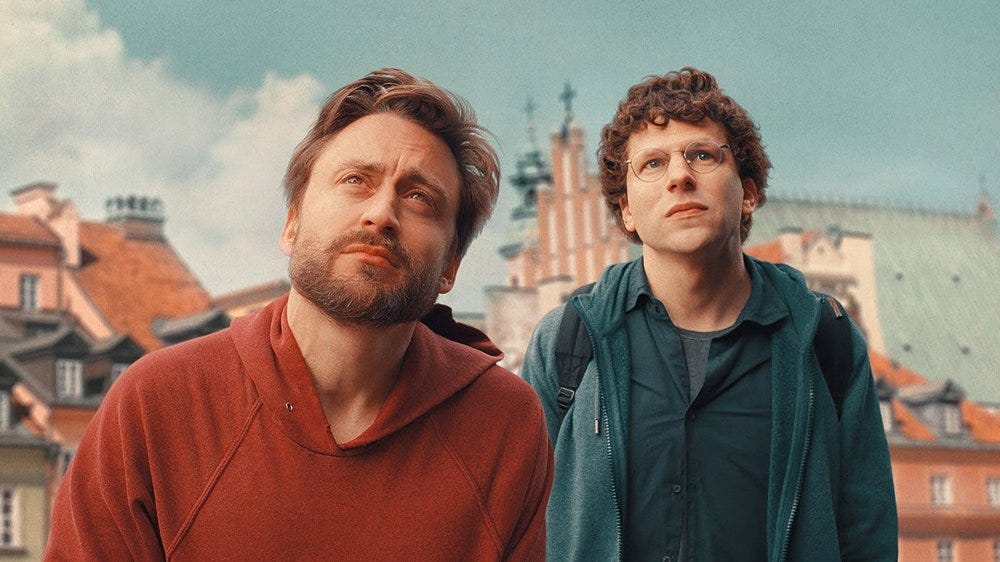
Full disclosure: my family has stopped taking movie recommendations from me. Apparently, I have a peculiar idea of what a good movie is. That is, I like “good movies” to have an aftertaste, to linger, to give me that rewarding feeling of having been touched in some undefinable way. This doesn’t mean I don’t enjoy “normal” movies - I very much do - although maybe those “normal” movies are enjoyable exactly because in some way they end up lingering, just in a more subtle way (I mean there has to be a reason for my fondness for “Ugly Truth” outside of my adoration for Gerard Butler, right?). Anyway, this “disclosure” (which feels more of a disclaimer now, since I should also add that I’m no movie critic and this will be no critique) seems to be turning into a preamble, so I’ll wrap up and get to what this post is really about - a couple of thoughts on the movie “A Real Pain” (exactly my kind of movie), or more specifically, the thoughts that after going down the Reddit rabbit hole, I didn’t see explored.
Sometimes I wonder who comes up with movie summaries for IMDb because if you watched “A Real Pain,” you know this sentence misses the point: “Mismatched cousins (Benji and David) reunite for a tour through Poland to honor their beloved grandmother, but their old tensions resurface against the backdrop of their family history.” And the point (at least in my interpretation, but you can also call it projection) is that this movie depicts different ways of dealing with pain, various costs that come with each, and how the chosen way influences others’ perception of that pain, the degree of its “realness.” I particularly appreciated the detached narrative of the movie in terms of not pushing any real agenda - it’s a slice of life that everyone gets to take something away from. Mine is just one such takeaway. (Quick side note: for the sake of this discussion, pain here encompasses the emotional torment inherent in depression.)
The majority of viewers on Reddit focused their discussion of the movie around Benji’s pain. Which makes sense - Benji’s pain is loud, attention-grabbing, ever-present, and completely unapologetic. He wears his pain on his sleeve - it’s such an integral part of him that he doesn’t give it a second thought, he doesn’t separate himself from it, doesn’t look at it as a part of him rather than the whole of him. And that’s what does him in, that’s what adds to the chaos he creates around him - he is his pain and his pain is him. I used to believe that removing shame from depression could greatly increase one’s ability to cope with it and even get better. And it is true, but to an extent. Because what seems to be happening with Benji here is that he pushed so hard against any idea of shame around his pain that he found himself on the other side of the extreme, the side of arrogance and disregard for the impact of his pain on others. It’s almost like he treats his pain as a moral cover, a justification, for being inconsiderate and occasionally cruel. And the fact that he is charismatic and his hectic free-spiritedness attracts people doesn’t help him to become aware of his shortcomings.
In contrast, the quiet tragedy of David, which remains unexplored on Reddit, is in his opposite approach to dealing with his emotional torment. David is so clearly in pain himself, but it’s a “managed” pain, it’s the remnants of pain that he still feels after all his suppression efforts as powered by medication and distractions. And it’s probably why he reacts so strongly to Benji’s careless dance with and around the pain. The way Benji talks about how pain should be brought into life, talked about, not hidden, that nobody should (or really could) be always well and happy - that whole normalization of pain, open recognition and acknowledgment of it - it seems to be logical and makes sense, but coming from Benji who takes it to an extreme, it also seems wrong somehow or at least wrong in the way it goes against David’s approach to pain management, and it irks him tremendously by possibly making him question that approach. Because there’s a certain degree of solace found in the perception of “there’s no other way” and it can be quite destabilizing to be shown that it’s not true, that this whole time, there have been other “ways” available to you - the stab of regret at being ignorant of those other ways tends to hide behind the reproach towards whoever has introduced them. After all, by reducing, through various suppression measures, his feelings of emotional agony, David has also been capping the available range of joy and elation in his life (a well-known side effect of antidepressants). It could be a painful choice to make - to feel less pain at the cost of feeling less joy - but it has given him a life he could manage instead of dread, and that’s probably worth it.
One scene that stuck with me in particular is the group dinner in the second half of the movie. There, when Benji makes a chaotic exit after spilling his pain on everyone at the table, David shares an assumption that I’ve mostly heard from people that had a recurring relationship with depression - an assumption that he doesn’t even realize is an assumption as he just takes it for the truth - that everybody is in deep pain, and as such his own pain is just unexceptional and doesn’t deserve attention. That right there really gnawed on my heart for quite a bit: the repressed longing for help, for alleviation of the suffering, but the longing crossed out by shame to admit its very existence, or even a right to its existence, to admit that he might be feeling ‘a real pain’ - the kind that should be addressed, not suppressed or diminished. The thing is that David too normalizes pain, but unlike Benji, his normalization feeds into his shame and auto-aggression, perpetuating his emotional agony.
What’s also curious is that similar to how Benji and David share in the emotional pain but differ in how they each deal with it, so too they share in arrogance but differ in how it comes across. As I mentioned, Benji’s pain creates the kind of arrogance that leads to his disregard for others and the way his pain impacts them. Meanwhile, David’s pain produces a slightly more nuanced kind of arrogance - the one that brings about the disregard for others’ ache as birthed out of his disregard for his own. One would normally expect that someone who’s known the depths of despair and apathetic agony of depression would exhibit more compassion towards others going through similar experiences, but that’s actually not always the case. Especially, when the person in question (David) has taken measures to bring their pain under some semblance of control. Surprisingly, that often leads to impatience around and frustration with others’ experiences with depression, especially when they do so in a more open, Benji-esque, manner. It becomes something along the lines of “I’m going through some shit too, and I’m not complaining or crying about it, and I’m not imposing my pain on others, and I’m dealing with it, so you should shut up and just deal with it too.” Projection 101, at its best and worst. Of course, it’s more nuanced (and subconscious) than that, but the point stands: by having certain expectations for himself in relation to pain management and rejecting his right to external sympathy and compassion, David might be doing the same towards others. Plenty of people going through depression will exhibit more compassion towards others than themselves, but even they might eventually come to resent those others (and themselves for that resent - the recursive tendencies of the human mind). So, Benji disregards David’s pain because he’s ignorant of it, and David disregards Benji’s pain because he compares it to his own. I don’t know which of the two expressions of arrogance is more harmful, since there’s too many approaches (and directions) to measuring the ensuing harm, but I suspect that David’s arrogance might be easier to address by bringing it into light.
Anyways, I’m going to leave you with this: everyone has their own experiences with depression, pain, anxiety, and all that messy stuff that kind of makes us human; so while it’s okay to not understand another’s take or experience with something, I’m sure we can all be more respectful to not invalidate the reality of the variety inherent in these experiences. After all, who’s to judge what constitutes a real pain?
Originally published on Human Condition on Substack.
Join the conversation
Leave a comment
Your comment will appear after review. Please avoid sharing private information.