Human Condition · Essays
The Allegory of The Cave - A Group Discussion
An imagined group conversation exploring truth, knowledge, and interpretations of Plato’s Allegory of the Cave.
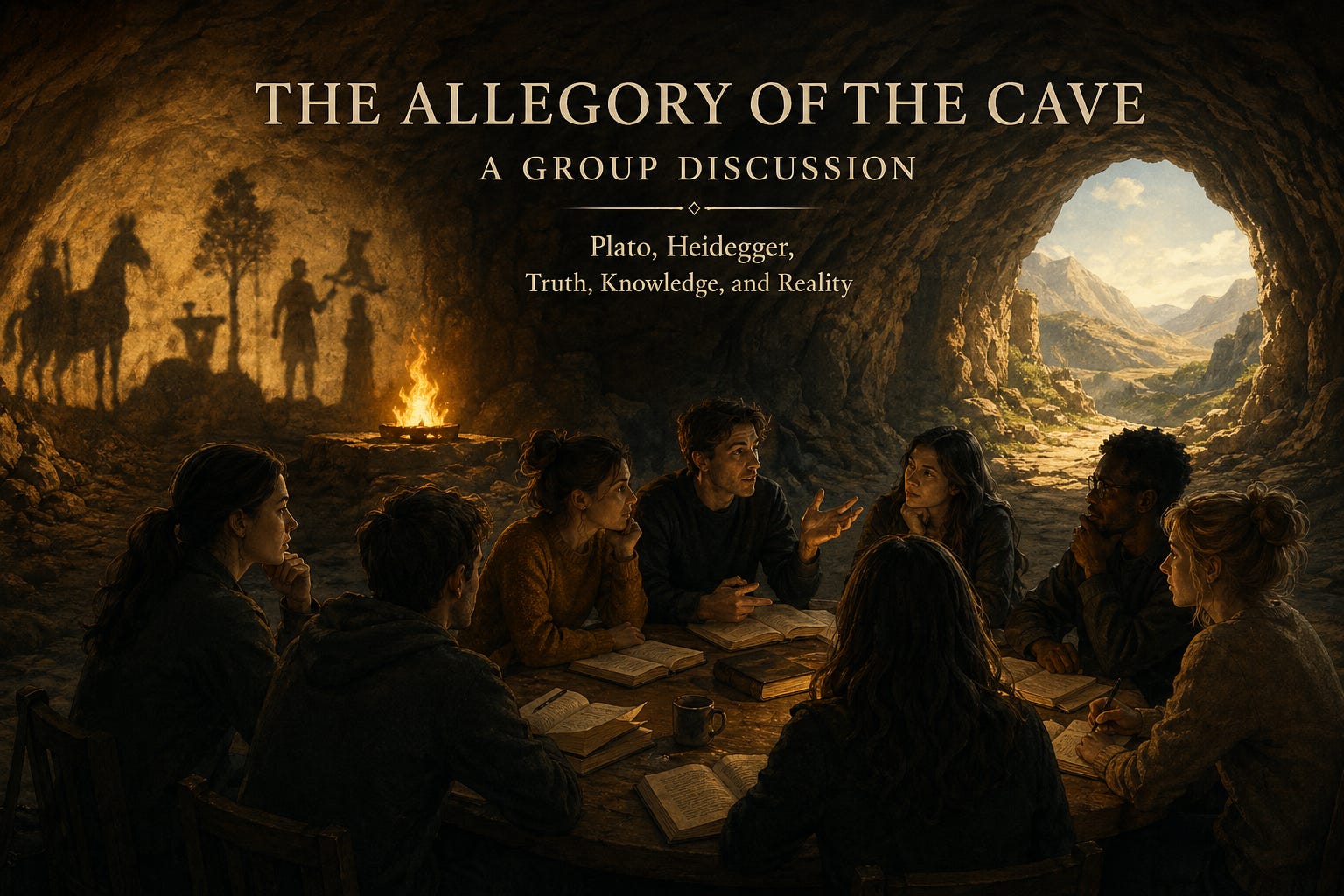
(SN: Strongly advising to read the actual texts that the discussion is based on first - The Allegory of The Cave from Plato’s Republic and Heidegger’s take on it.)
Abbie cleared her throat: “Alright. We’re going to dive right in. And our first discussion question will be: What did Plato really mean by ‘truth’?”
Brandon looked around before raising his hand: “I guess, I’ll go? He kind of looked at truth as ‘correctness’ - making sure that ideas are matched to reality, that they are correct. His whole focus was on learning, knowing, educating, and bearing the responsibility to continue to ensure knowledge is passed on and spread around. So, truth to Plato was knowledge, or rather, correct knowledge, and it required access, it required evaluation, a sort of consensus on what is correct.”
Cate shook her head: “Argh, that bothers me so much - because correct according to whom? That makes it sound like truth isn’t an inherent attribute of the objective reality but rather whatever received the most votes. Sure, it’s not so simplistic as that, but someone needs to determine correctness, right? So, there’s this sort of appeal to authority inherent in Plato’s truth.”
Diane nodded at Cate: “It sounds like your distaste for Plato’s truth might lead to your appreciation of Heidegger’s take on it.”
Cate tilted her head to one side: “Maybe? If I’m honest, I’m not sure I fully grasped Heidegger.”
Abbie smiled reassuringly: “Don’t worry, we’ll get to Heidegger. But let’s stay with Plato for a little while longer. You raised a good question there - correct according to whom? Any thoughts?”
Brandon: “Well, it’s obviously not the majority - majority-determined truths have been wrong so many times - the earth-centered cosmic models, Christian Crusades, the denial of black holes - the list is infinite. In fact, the groupthink inherent in the majority-determined truths can severely undermine the possibility of those truths to be correct.”
Diane narrowed her eyes: “You might be confusing positive and normative views there because what you are saying is that the majority shouldn’t be the authority on correctness, which is normative. But the reality is that majorities determine the containers, the limitations, and the definitions of ‘correct’ truths every day. That’s how our society has evolved to function. And not just ours.”
Brandon: “Well, yes, that’s my point kind of - I was thinking about the question that Abbie, or actually, Cate posed normatively - who should be the authority on correctness?”
Cate: “Well, ideally, it should probably be those who have repeatedly engaged with the knowledge to build an experience with it, no?”
Diane: “In practice, regardless of the criteria we might come up with, one thing will be true - authority will be determined in terms of humanity, one person or many, but it will be humans. Which is why I suppose Plato is considered foundational to the inception of humanism as a concept - the whole ‘reality doesn’t just exist but exists for us’.”
Abbie: “So is that how Plato changed the way Western thinking works?”
Brandon straightened his shoulders slightly: “But did he? I mean did Plato actually influence Western thinking or did he merely reflect the truth of it - you know, in Heidegger’s terms, ‘unhid’ it?”
Abbie: “Alright, let’s turn to Heidegger. What did you all think about the text in general?”
Cate looked up from her notes, more shy than usual: “As they say - you are either smart enough to read Heidegger, or smart enough to avoid him. Just kidding, I’m kidding - it’s more something like: you are either smart enough to read Heidegger, or more than smart enough to actually understand him. And the uncomfortable truth is that I’m not any of those. I’ve tried, time and time again, but if I’ve ever thought that I have a confusing mind, it pales by comparison to the confusion that is Heidegger’s mind.”
Brandon grunted: “I’ve actually never heard anyone say that, but I’d agree. I am also none of those, and also not for the lack of trying.”
Joan jumped in, apparently inspired by Cate’s honesty: “Yeah, his writing is so… exploratory, circular, and at times contradictory, or worse - repetitive. And it is almost completely unstructured.”
Elijah raised his eyebrows: “All of that is intentional actually - he was a professor after all, so he strived to not just present ready ideas but take you, the reader or his students, along into his thinking process. Which then allowed him to demonstrate how he arrived at all those original bits of ideas he shared. But I also wish he’d occasionally tried a different approach for a different kind of a reader.”
Fiona nodded agreement: “I agree! You’d think that if he wanted more people to take to his ideas, he’d make the journey towards them a bit more manageable.”
Diane narrowed her eyes: “Or… You know, it could also be a very clever ruse - make his writing intentionally so obscure that only a few people would engage with it, limiting opportunity for criticism, which would either add to his self-aggrandizement or to the laments about how people aren’t ready for his ideas. That whole appeal to being a ‘misunderstood genius’.”
Brandon attempted to moderate: “How about we give him some benefit of a doubt here? Like a slightly more innocent take? Maybe, just maybe, the dude simply wrote for himself, and as long as it made sense to him, that was all that mattered. No intentional obfuscation. No pursuit of self-aggrandizement. ”
Abbie tried to not smile but failed: “You guys are really bashing on poor Heidegger here - I mean, I’m not going to say that I’m not amused by it, it’s just, yeah, I guess it is amusing.”
Diane made a snorting sound: “Look at us - we finally found something we all agree on, at least to some extent.”
Elijah gave a meaningful look around before speaking: “I guess I’ll say what we might all be thinking - obviously, we’re not really bashing on ‘poor Heidegger’ - well, no more than I was bashing my head against my desk trying to digest his writing - I’d say we’re just trying to somehow excuse or justify our struggle to comprehend him. I mean, it’s a bit comforting and uniting that most of us struggled with the text.”
Cate looked down as she shook her head: “Struggle doesn’t even begin to cover it. I actually ended up asking ChatGPT to help me grasp the essence of the text, explain certain contradictions and nuances, and just engage in a conversation with me, since that’s how I learn best. There, I said it! Feel free to judge me now - after all, I am judging myself for this ‘weakness.’”
Diane: “No judgement here. I wouldn’t even call that a weakness - you engaged with the text and sort of had a peer tutor to help you process it. I think that’s what makes active learning different from information consumption that’s become so popular these days. Just make sure to not take ChatGPT’s assertions at face value, that’s all.”
Fiona: “That kind of unhides an additional layer to our earlier chat on correctness and authority - if we don’t interact with truth directly but rather leverage the interpretation, translation, or formation of it done by others, including ChatGPT, are we then defaulting to their authority on what counts as correct? Like under what criteria should we treat ChatGPT as an authority on truth?”
Brandon: “Under none? It’s so subjective in its delivery and presentation!”
Elijah: “I don’t think objectivity is something available to any thinking and reasoning being to begin with. It’s an abstract human-centered concept that exists in the realm well beyond Plato’s orthotes.”
Joan rolled her eyes: “English, Elijah, please.”
Abbie jumped in to steer the conversation back on track: “Actually, since we’re back to discussing truth, why don’t we look at Heidegger’s take on it? Heidegger claimed that Plato unintentionally reduced truth from something happening in reality to something judged by humans. What do you all think about that?”
Brandon: “Well, Heidegger is obviously a romantic with a soft spot for nostalgia. His whole thing was that we had already had it right before, so we should go back to the original way of thinking about truth - the pre-Plato way: truth as emergence, truth as unconcealment, where things that already exist - that already are - simply reveal themselves. Truth as the reality unfolding.”
Cate: “I think, if anything, Plato was probably looking for a way to deal with the discomfort that arose from the limitations of his knowledge. He knew that truth was bigger than him, than all of humanity, so to get an existential grip on that knowledge, he flipped things on their head and declared truth outside of humanity as meaningless.”
Abbie clapped her hands: “There’s so much to unpack here!”
Fiona interfered: “This is where it gets muddled for me - I get that truth might exist without us, but our interaction with and interpretation of it kind of makes it exist for us, no? At least within the bounds of our subjective realities. I mean we are not separate from reality - we’re part of it. So I’m not sure how Heidegger manages to separate these notions so cleanly in his head.”
Elijah: “Well, I don’t know if he’s actually separating them. I do agree with Heidegger about aletheia - fine, fine, truth as unconcealedness - being something that just happens in reality outside of us, but to your point, I think the real truth is somewhere in the middle, in the dialectics, which Heidegger might be hinting at without actually being a dialectician himself.”
Brandon: “There is an undeniable relationship between facts and knowledge: truth as facts, as unhiddenness, the ontological concept of ‘what is’ that exists independently; and truth as knowledge, the epistemological notion of ‘what is for us’ that is acquired and processed. We take something that exists independently - factual reality - and through our interaction with it, we turn it into something that exists for us - a subjective reality, which is just an incomplete truth.”
Fiona: “Reality as unhiddenness in the waiting. That’s kind of what I said earlier.”
Brandon: “Yes, sorry, I was just trying to formulate these thoughts and make sense of them.”
Fiona: “No worries, it’s actually kind of nice that we both arrived at the same conclusion there: ‘what is’ turning into ‘what we know.’ Pretty much, human experience with truth will always be through a subjective lens of what’s currently known and available.”
Elijah: “I like that. It’s reflected in our relationship with science, or rather science reflects this relationship between facts and epistēmē or knowledge. Black holes and gravitational waves existed before our discovery thereof, which is truth as reality. But until we detected them, they didn’t exist for us. It was only once we confirmed their existence that orthotes - the truth - of our reality got updated and expanded and made more correct.”
Abbie smiled: “Truth as unhiddenness alone is inaccessible, and truth as correctness alone is delusional! You know the conversation unfolds well, when the moderator wants to jump in as a participant!”
Elijah: “Yeah but there’s something about truth and knowledge that bothers me, or rather the implied - or should I say imposed - responsibility to reach for orthotes as the highest agathon or good. In Plato’s view anyways. Okay if I think out loud here while I’m trying to figure this out? When it comes to knowledge, we’re constantly bombarded, whether consciously or not, by the need to make decisions, choices, and conclusions on whether we know something, as well as whether the not knowing should then prompt us towards knowing - you know, towards learning - because there’s this implied judgement of apaideusia or ignorance as something to be overcome. But the overcoming is costly in terms of time, energy, and effort, and so our default state, just like the state of those people in the cave is to assume knowledge, however surface and shallow.”
Brandon: “I think I see what you mean - after all, it’s much easier to assume we know something up until the point it is subjected to a test. That is, we allow ourselves to be lulled into the comfort of presumed knowing because not knowing activates a need for the pursuit of knowledge. But because subconsciously we know what we don’t know, we’ll be resisting or staying away from situations that might put our knowledge to a test. Because if we never test what we think we know, then we can never really know whether we actually know it? You know?”
There was a comforting sound of a collective chuckle.
Diane added with a meaningful nod: “It’s Yudkowsky’s invisible dragon allegory and his whole double-down around there being a universal truth out there that doesn’t depend on the subjective evaluation of its correctness by anyone.”
Elijah, who didn’t seem to connect with Yudkowsky, continued on an earlier point: “And because epistēmē or knowing is usually lauded with admiration and agathon, we cling on to the idea of knowing or convincing ourselves that we know. But there’s something inherently flawed in viewing truth as a virtue - agathon - or rather imbuing it with value, with meaning - those qualities shouldn’t be defining whether something is truth.”
Cate: “I agree - they are, after all, entirely human concepts and wouldn’t exist without humanity.”
Diane: “It’s funny but I think that’s precisely Plato’s point - since truth exists for us, and the quality of value and meaning don’t exist beyond us, then they are perfect qualifiers for truth.”
Fiona: “I’m going to need to sit with that thought for a moment.”
Brandon: “I actually want to go back to where I think Elijah was going earlier. Truth is unhiddenness - the remembrance of what was forgotten, according to Heidegger anyways. Truth is the uncovering of what’s already there, the apperception, the grasp on what’s outside of us. But doesn’t that very uncovering of truth result in gaining knowledge?”
Joan: “I like where this is headed. Heidegger tries to argue truth away from correctness and by association from knowledge, and sure, truth and knowledge aren’t synonymous, but they do have a relationship with one another. And isn’t truth an abstract, an idea, a concept subjected to instantiation in order to exist in the real world? How does he separate the two? Or does he? I think I’m missing something.”
Abbie: “It might be helpful to discuss the concept of education here.”
Joan: “Well, Plato looked at education as a transformation of the soul’s orientation - becoming able to see differently and open to the unhiddenness, which is truth.”
Cate: “So for education to be complete, one has to arrive at the complete reorientation of the soul? Isn’t there credit for partial learning?”
Elijah: “I think this is where it’s important to acknowledge that not all ‘paideia’ or education has to lead to some existential transformation. And that’s because there are different types of learning - informational, skill-based, ontologically fundamental - and not all of them are going to change our relationship with truth and reality.”
Diane: “All education is learning, but not all learning is education, at least in Plato’s sense.”
Brandon: “Yeah, it’s almost like the defining order should be reversed - it’s not that education transforms your relationship with reality, but rather that if you find yourself engaging differently with reality, then what led to that change is education.”
Cate: “I’m going to be that person and ask - why does this matter? Tom[ei]to-tom[a]to! What difference does that make?”
Diane: “You’re right - it doesn’t make a difference to Heidegger’s truth, but it does to Plato’s.”
Fiona interfered before Cate could respond: “Sorry if this is a tangent, but you know what I don’t get? Why is there this assumption that transition is necessarily painful? I mean that whole ‘going from the darkness of the cave to the brightness of the light outside of it’ or vice versa is assumed to be painful, blinding, destabilizing, but it doesn’t really have to be, right?”
Joan and Cate nodded adamantly and looked around.
Brandon cleared his throat: “Mmm, I actually don’t have qualms with the assumption of transition being painful because transition is change, and change, whether positive or negative is perceived by the brain as stress. And the degree of the change, the degree to which it uproots one’s perception of the world and the foundation for that perception, may be so distressing that the transition wouldn’t even be made complete - it would be paused somewhere where the pain of the transition exceeds the expected benefit from the transition.”
Diane: “Yeah, and to add to that - I think the painfulness of the transition is there to hint at how easy it can be to stay with the status quo when the choice is between the comfortable known and uncomfortable unknown. It’s truly incredible how predictable misery may be preferred to unpredictable happiness. We probably all have stayed in some relationships or jobs way past their expiration dates, unwilling to engage with the change…”
The group exchanged asynchronous nods of agreement.
Elijah: “It then makes sense why Heidegger viewed aletheia as something that provides shape and imposes limitations. The limitations here can also be alluding to the limitations of one’s awareness and awareness of one’s limitations, or more specifically the limitations of the comfortable known - to the extent there’s even awareness of them - might not be enough of a catalyst for the tinkering with the unknown and its promises that might hide behind the initial discomfort.”
Cate smiled: “Or to put it more simply - ignorance is bliss. I mean it truly is. Especially in the way its fragility resembles mirage - because once the brightness of the daylight becomes known to the caveman, he would now never unknow it. He can choose to ignore any further pursuit of it, but he’ll be confronted on some subconscious level with the fact that what he knows isn’t all there is.”
Brandon: “All of this is to say that changing one’s position, conviction, or foundational truth of their reality will always be costly. The realm of transitory discomfort may comprise of different types of pain: neurological, emotional, existential, relational. Change is disruptive and costly. So I think we should take at least some responsibility for considering these costs when imposing a change on someone.”
The group fell quiet for a few moments. But before Abbie could intervene with a new prompt, Cate cleared her throat.
Cate: “I got to read the records of Socrates’s conversations recorded by Xenophon, and his delivery and commentary on Socrates differs from Plato and very obviously exposes the biases that both admirers had the imprudence to attribute to the object of their admiration. Shouldn’t we also talk about the interpretation gap and perception bias - I mean Socrates lives the story, Plato then retells it and probably mixes in his own attitudes in it, and then Heidegger interprets something that’s already layers removed from its origin.”
Abbie: “Ah, I can see how this can be confusing. Plato indeed attributes the story to Socrates, but there’s no evidence that Socrates was the one who came up with it. So, it’s actually Plato’s story, he just tells it from Socrates’s perspective. But yes, maybe we can be a bit more consistent when we talk about it.”
Cate put her hand over her eyes: “I feel really stupid now…”
Diane leaned a little forward: “You shouldn’t. If you read Socrates by both Plato and Xenophon - that’s already more than most people. Seriously. And you raised a good point about the perceptions and interpretations.”
Joan nodded: “I agree - I think in essence you hit the nail on the head - we are discussing an interpretation of an interpretation of a possibly fictional conversation, and sort of trying to uncover truth in it. And not to start another tangent, but a great example of an alternative interpretation is to look at the cave and the transition to the surface as an allegory for personal transcendence and levels of death one must go through for each transformation.”
Abbie jumped in: “That’s a great alternative view - thank you, Joan. Let’s park it for now and discuss it in the context of Nietzsche next time, after we finish with Heidegger and Plato, okay?”
Joan nodded again.
Brandon: “Well, there’s definitely a degree of inherent subjectivity in the interpretations and delivery of the allegory by Plato and Heidegger. And it does raise all these questions: like why did Plato choose to attribute the cave story to Socrates rather than claim his authorship over it? Was he appealing to Socrates’s authority? Did he consider himself one of the enlightened people subjected to the duty described by his made-up version of Socrates to go back down to the cave and bring more people to light? And if so, did he accept that duty or rebel against it?”
Elijah: “Well, given his focus on ‘everything leads to death in the end anyways’ - which sounds a touch nihilistic, of course, but maybe isn’t - I would argue that he rejected the implied obligation in the allegory by calling towards agency and autonomy of the person - the idea of the person - rather than individual responsibility. And maybe that’s why he didn’t write it from the first person - he wanted to establish some distance for navigation.”
Cate raised her hand, quickly lowered it, then looked uncertainly around, caught Diane’s encouraging nod, and finally said: “Eh, wouldn’t that kind of individual responsibility - to go ahead and impose your own enlightenment on others - have to be rooted in a certain degree of arrogance in order to make the presumption that your interference will be good for them? You know that whole egocentric generalization and extrapolation that what’s good for me should also be good for others and that they might not choose to know yet but that’s because in their ignorance they cannot make such a choice and so I then have a right, a responsibility even, to make the choice for them.”
Brandon: “That’s actually an interesting point - Plato does sort of argue that once you’re exposed to the truth, you have the responsibility to erase ignorance wherever you spot it, but that implies a high degree of certainty in the correctness of your knowledge - your truth - which, as you noted, would be hard to distinguish from arrogance. I mean his allegory sort of judges, if not openly ridicules, the cave people for worshipping shadow figures when he and the rest of the Greeks were worshipping their twelve Olympians, who in essence were no less of shadow figures themselves.”
Fiona: “This kind of goes back to our earlier exchange about the authority on correctness.”
Elijah: “And also the responsibility to educate. I think Plato’s whole argument for justified hubris - even if he doesn’t call it that - is based on the fact that apaideusia or ignorance doesn’t reveal itself to its object, to the person afflicted by it. So someone else then must bear the duty of dispersing it.”
Brandon: “I don’t suggest that we discuss it now, but I do want to question the negative implication we assign to ignorance. The only justifiable reason for that is the assumption of virtue in truth, which is only available in the human-centered model of the world.”
Diane: “Which is why we have Heidegger demonstrate preference for ignorance over arrogance, as part of his rejection of the humanistic model.”
Brandon: “Maybe? I get that Heidegger wasn’t big on dialectics, but to the earlier point made by Fiona, I really think that his model was more about allowing a sort of a coexistence between the two - you know, this recognition that while truth as unhiddenness exists out there perfectly and completely, our grasp of it will always be limited, muddled, and incomplete. So it becomes about maintaining a dynamic balance of the two positions: that truth as knowledge possessed by us is correct enough for us to interact and build on it, and that truth as a factual reality exists independent of us and we might never know all of it, but we can continuously update our truth as knowledge by engaging with and unhiding more of truth as a reality.”
Diane: “You might be giving Heidegger too much credit - I don’t think that was ever part of his argument - but I do like your and Fiona’s dialectical approach there. Just don’t attribute it so completely to Heidegger or your interpretation of him. Own it. Seriously. It’s a good argument.”
Brandon shrugged noncommittally.
Elijah: “Yeah, and because when Heidegger is contemplating the allegory, he’s considering it from his own context - I mean he lived through two world wars, the creation of the atomic bomb, the technological disruptions, and all that. So it’s contextually congruent for him to invite everyone to stop the pursuit of truth as orthotes in Plato’s sense and just let the reality unfold itself - kind of makes sense why he might be more attuned to Nietzsche and nihilism.”
Fiona: “I haven’t thought in terms of his context but that actually makes sense. Although his support of the Nazi party is still confusing to me.”
Diane: “Only if you expect moral congruence, which most philosophers failed to establish in some aspect of their life.”
Abbie: “I’m sorry to be the bearer of bad news but we’re at time! Thank you, everyone, for this insightful discussion. Next time, we’ll dive into the ideological relationship between Heidegger and Nietzsche and will make sure to touch on the point shared by Joan about personal transformation and death.”
P.S. So, a bit of background. I recently went to a very curious philosophy discussion. I missed the beginning of the conversation though, which left me a little uncertain about the objectives of it and the agenda in general, so I ended up not saying a single word. Just listening to others. I should also note here that that kind of wallflower listening mode is a default for me in group settings since I tend to engage in a lot of analysis of group dynamics and the conversation at hand. Supposedly, that kind of excessive analysis is to help me determine my place in the group and how my own discussion positions correspond to those of others, so that we can have an effective conversation. But as you can guess, the analysis takes too much of my attention and I usually miss out on any chances to actually participate. Anyways. Since I didn’t get to share any of my thoughts during the discussion, I figured I would do it here :)
I also ended up writing my own take on The Allegory of The Cave that more directly explores the transitory states.
P.P.S. AI disclosure: ChatGPT was leveraged to create the image for this post and check grammar/spelling/punctuation.
Originally published on Human Condition on Substack.
Join the conversation
Leave a comment
Your comment will appear after review. Please avoid sharing private information.